
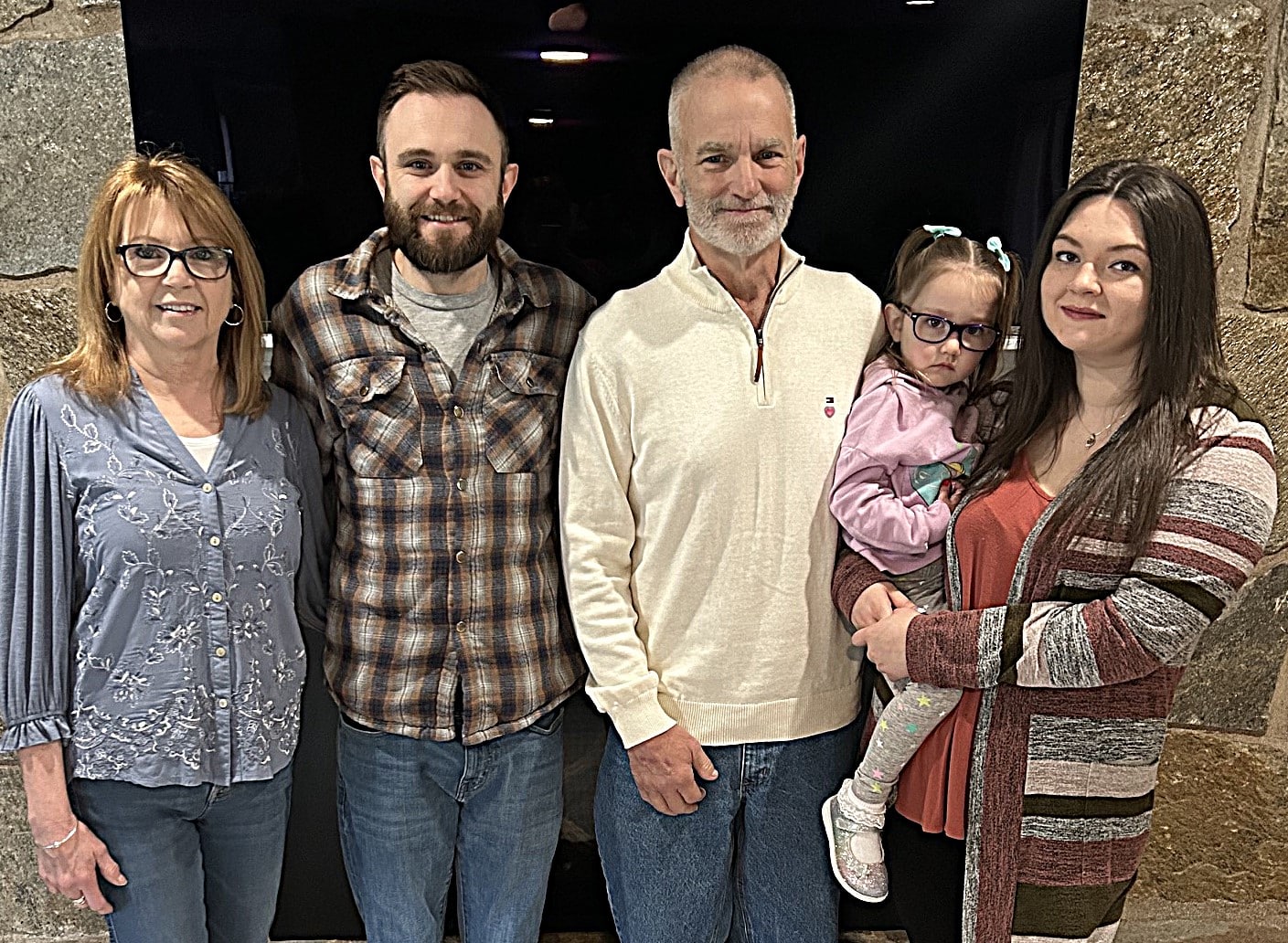
Theodore “Ted” Pinkerman of West Springfield urgently needs a kidney transplant from a living donor. He is shown in this photo with some of his family members. From left: Kathy Pinkerman; their son Teddy Jr.; Ted Pinkerman; Kayla Cook (Teddy Jr.’s fiancée) holding three-year-old Hazel.
Reminder Publishing submitted photos
WEST SPRINGFIELD — Fifteen years ago, routine bloodwork revealed that Theodore “Ted” Pinkerman had kidney damage.
The diagnosis changed his life.
Pinkerman began doing everything possible to protect his health. He lost 65 pounds, improved his health dramatically — even reversed his Type 2 diabetes — and worked hard to stay active and strong. But his kidney disease continued to progress.
Pinkerman now has Stage 4 kidney disease. His doctors have told him his best chance to live a longer, healthier life is to receive a kidney transplant — preferably one from a living donor. He is currently on the deceased donor transplant list, but the estimated wait is six to seven years.
Unfortunately for Pinkerman, his kidney function continues to decline, so time is not on his side. “My primary care physician as well as the staff of nephrologists and kidney surgeons at Baystate Medical Center’s transplant program have decided it would be better for me to have a kidney transplant sooner than later. The outcome would be better for me since I’ve worked so hard to stay healthy,” said the lifelong West Springfield resident.
Throughout his life, Pinkerman has always tried to help others. He spent 35 years working in information technology in addition to mentoring many young soccer players as a Pioneer Valley travel team soccer coach. He currently has his own home inspection business that helps families through one of their biggest decisions: buying a home.
Reminder Publishing submitted photo
Pinkerman is now reaching out for help with a deeply personal request: finding a living kidney donor. “I never thought I’d be in this position of asking for help. It’s difficult because I’m a very private person,” said the 63-year-old father and grandfather.
“A living kidney donor could save my life,” said Pinkerman. “Most donors go on to live healthy, normal lives with one kidney, and every donor is carefully evaluated for safety. Less than one percent of people ever needs a kidney after they give one. Think about that. It’s an amazing statistic that the public needs to know to calm any fears of donating.”
Pinkerman’s immediate family members wanted to donate, but due to medical conditions, they didn’t qualify. Susan Moore, one of his sisters, who lives in Ashburn, Virginia, with her husband, wanted to help her brother in any way possible. So, both went through the process to see if they qualified medically to donate.
“They walk you through everything, and are very careful to make sure it’s absolutely safe for the potential donor,” said Moore “They also make it clear that you can step away from the process at any point, so there is no pressure to commit right away. We weren’t able to donate, but I hope others will consider getting tested.”
Pinkerman’s family is concerned for him and have rallied around him to help — hoping someone can step forward to donate a kidney. “I want to see my almost 3-year-old granddaughter Hazel — the love of my life — grow up. My son Teddy, who lives three houses away from me, is planning on getting married soon and has a second little girl on the way.”
Teddy Pinkerman, Jr., said his father’s disease is “a very intense and overwhelming situation” for him and his family.
“It would be great for my dad to see us get married and watch his two granddaughters grow. He’s hoping to watch his granddaughters play soccer as they get older, as we have always been a big soccer family. We’re doing all we can to get his story out there. Anyone who can help spread the word, or share a personal experience with this type of situation, would be very much appreciated,” he said.
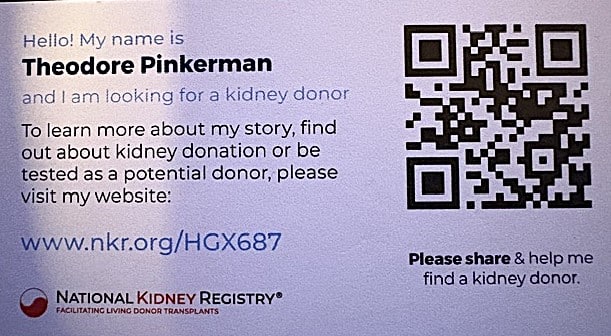
A matching kidney would be ideal, said Ted Pinkerman, but a direct match is not necessary. For example, a kidney may be donated on his behalf through the National Kidney Registry to help another person in need, but who also has an incompatible donor.
“I would receive a compatible kidney from a donor donating on behalf of an incompatible recipient. That recipient would then receive a kidney from a different unmatched donor-recipient pair,” said Pinkerman.
The NKR would issue a voucher to Pinkerman, which is like an IOU for a kidney. The NKR employs data from across the U.S. to match donors with compatible recipients. That increases the number of transplants performed yearly and makes for the best patient outcomes.
“A donor donating a kidney on my behalf would have their costs of hospital and medical care covered. In addition, Donor Shield Protections (including lost wages, room and lodging and more) available only through the NKR may also be available,” he added.
Pinkerman isn’t having any symptoms currently because he got himself in such good shape knowing that he will need a kidney transplant at some point. But his doctor recently found that his kidney function dropped below 15 — which is why he needs a new kidney.
The 1984 American International College graduate is hopeful he will find a living donor within the next few months or within a year because there are new programs within the National Kidney Foundation. These allow people to donate their kidney whether or not they’re a match to the recipient’s blood type.
“It was never talked about in the past when it was scary. Now the NKR makes sure that you’re healthy enough to give a kidney first and foremost,” said Pinkerman. “If you are, it doesn’t matter what your blood type is. They do all sorts of paired matching and voucher programs and if you’re not a match, it still could save my life.”
Pinkerman said the more people who can share his story with friends and family increases the number of people who may consider a kidney donation. “You can also support me and other patients in need of a transplant by being screened to become a kidney donor with the NKR. The process is easy to complete and potential donors have access to the NKR’s nationwide donor support network.”

You must be logged in to post a comment.