
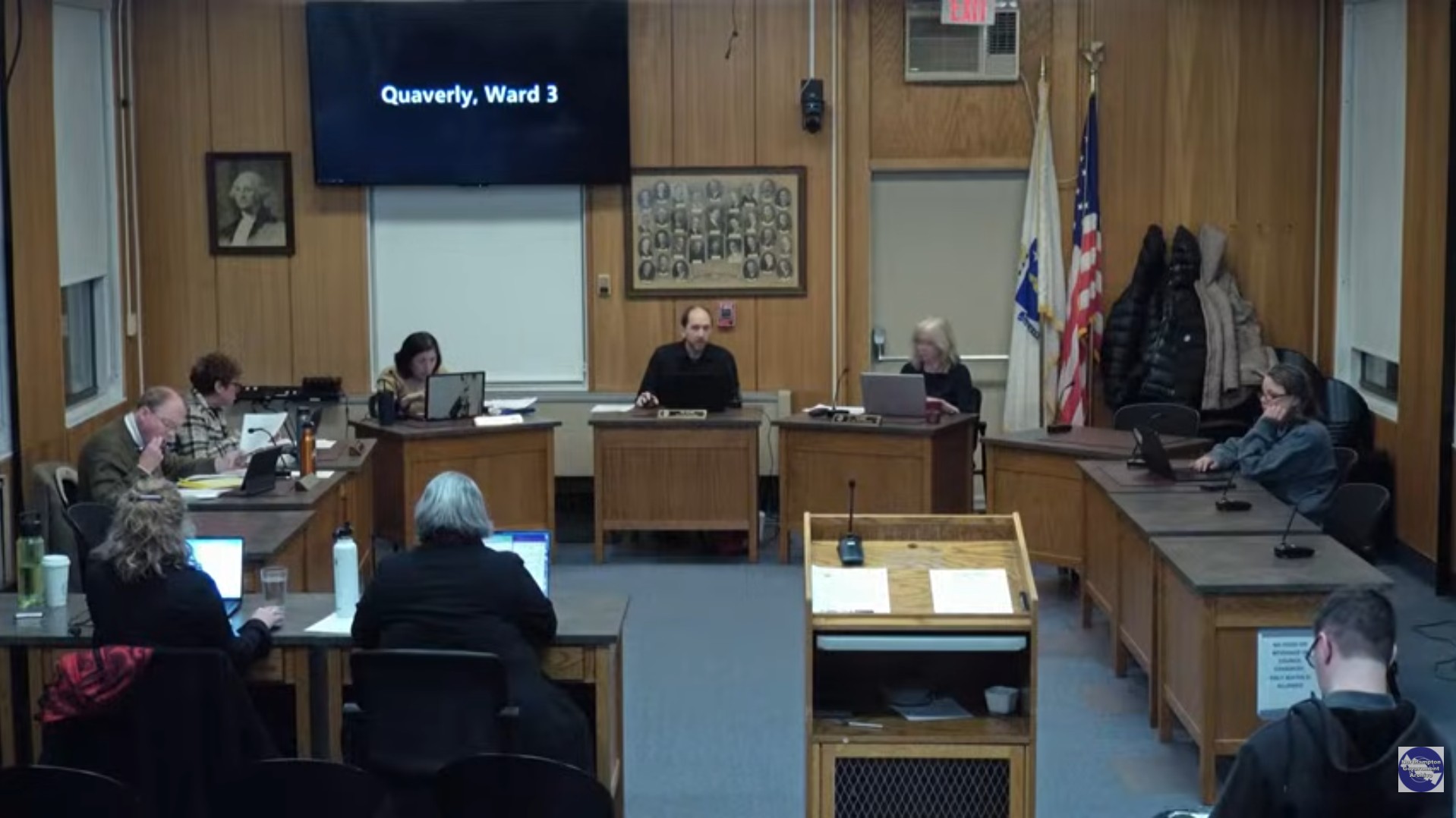
The City Council was originally supposed to vote on three financial orders for school energy projects on Dec. 4, but a charter objection delayed the votes until a Dec. 9 special meeting.
Photo credit: Northampton Open Media
NORTHAMPTON — Three school energy project financial orders were passed during a Dec. 9 special City Council meeting after the planned vote the week prior was delayed due to a raised charter objection.
The three financial orders total $11.5 million and will go toward projects aimed at reducing carbon emissions in the city’s school district, as part of the city’s continued efforts to achieve carbon neutrality for all city operations by 2030.
The projects include installing a rooftop solar array at Ryan Road Elementary School, a solar-generating parking lot canopy for Jackson Street Elementary School and a geothermal heating system at Northampton High School.
With the financial orders passed by the council, the city must appropriate around $2.5 million from its Climate Stabilization Fund and borrow $9 million for the funding of the Northampton geothermal project. For the Jackson Street solar canopy, the city would enter into a 25-year purchase agreement with the company, Solect Energy Development.
The orders also state that the new energy systems will help reduce heating and maintenance costs, and are also eligible for federal tax credits and the state’s Mass. Save rebates.These savings will be used to pay back the loans taken for geothermal.
A charter objection on the items was raised by Ward 3 Councilor Quaverly Rothenberg during the council’s Dec. 4 meeting the week prior. According to council rules, the first time a vote is made on an adoption of a measure, a single member can raise a charter objection that postpones that vote until the council’s next meeting.
At that meeting Rothenberg, who has raised various charter objections during her term on the council, said she called for the charter objection due to concerns there was a lack of transparency from the council in trying to sign these orders. The council had to postpone the votes until Dec. 9 due to this objection.
During the Dec. 9 special meeting, Northampton Finance Director Charlene Nardi and Climate Action and Project Administration Director Ben Weil explained that the projects are tied to federal energy incentives, which meant that the financial appropriations needed to happen by a Dec. 31 deadline.
If the council waited until next month, the city would have lost its tax credits, according to the department heads. The Northampton School Committee voted to approve all three projects at its Nov. 13 meeting.
The first financial order passed during the special meeting was an appropriation of $455,763 from the Climate Mitigation Stabilization Fund for the purposes of installing a solar photovoltaic, or PV system at Ryan Road Elementary School, with the tax credits being credited back to the Climate Mitigation Stabilization fund when received. The council passed this order unanimously.
Weil explained that the transfer of funds will move the project forward and avoid unnecessary costs. He said it is best practice that a roof slated to hold a solar PV array have sufficient life remaining so that re-roofing is unlikely needed during the array’s lifetime.
“This would be a purchase. In other words, because the roof is in good shape, and therefore, the total cost is lower, we can actually afford to just buy [the solar PVs]. It is a much better deal for the city to be able to buy it. We would own the panels, we get 100% of the value of their production and of the smart incentives,” said Weil.
Weil also explained that the roof and electrical infrastructure at Ryan Road Elementary School is capable of supporting 180.2 kilowatts of photovoltaics, which will typically produce 186.6 megawatt hours of electricity per year, providing the Northampton Public Schools with estimated average net operating income of $63,318 per year, and an approximate $1,582,941 savings and revenue over the 25-year nominal life of the array.
The investment of $455,763 in photovoltaics at Ryan Road School will help the city secure a federal investment tax credit of $136,279 if the project is contracted and some materials are ordered before the last day of the calendar year. The after-tax credit investment cost would be $319,484 and would have an internal rate of return greater than 17%, as well as a simple payback period of just over five years.
“I think the main point that I would want to make is that this is a transfer from an investment by the Climate Stabilization Fund toward the operating budget of the schools, in an average amount of about $63,000 and some change,” explained Weil. “This will continually deposit that amount into the school’s operating budget for 25 years or more. So, I feel like this is a pretty strong argument that this is helpful to the operating budget of schools.”
The second order passed through an 8-1 vote, with Rothenberg the only councilor to vote “no.” This order authorizes leasehold interest in the parking lot of Jackson Street Elementary School and a 25-year lease and power purchase agreement for canopy solar installation at the school.
“The difference in that case [as compared to project at Ryan Road] is we’re not paying any money up front,” explained Weil. “This is a transfer of resources to the operating budget of Northampton Public Schools. A smaller amount, almost $43,000 annually in savings, to the NPS operating budget.”
Jackson Street School is currently in need of re-roofing, therefore it is not appropriate for the installation of photovoltaic arrays. Because of this, the power purchase agreement will enable the construction of solar canopies over the parking lot at Jackson Street Elementary with no upfront cost to the city or to the school district.
Weil explained the current cost of electricity is 18.4 cents, and current cost of virtual net metered electricity production is 17.4 cents, both changing with markets and likely to increase. The cost of the electricity produced by these solar canopies will be fixed for 25 years at 15.8 cents per kilowatt hour at Jackson Street School, and a proposed power purchase agreement will provide culminative savings of $1,092,570 over 25 years.
“The company that builds and maintains and is responsible for the PV array at Jackson Street, any energy produced by that, we have agreed to buy at a fixed rate, and depending on when we do this actual contract, we will find out what that actual rate is,” Weil said. “But based on the current conditions, it would be about 15 cents per kilowatt hour, which is better than the almost 19 cents per kilowatt hour we pay now. So, it’s a commitment to purchase the production for 25 years.”
The final order passed authorized the appropriation and borrowing for the installation of a geothermal system at Northampton High School. The order authorizes the use of Climate Stabilization funds and municipal long- and short-term bonds to finance the design, installation and construction of a geothermal heating and cooling system at the high school.
The order was passed through an 8-0-1 vote, with the lone abstention being Rothenberg, who left the meeting before the vote.
Weil explained that the geothermal system allows for the building to cool thanks to the high efficiency ground source heat pumps. He added that the current chillers are well past their expected useful life and will need to be replaced within five years at the latest.
On top of the chillers, the high school’s boilers are also nearing the end of their expected useful life if continually operated. Weil explained ground source heat pumps are protected from the elements and have an equipment lifetime of 25 to 30 years.
“I think it is important to consider that it will actually improve comfort and thermal performance of the school, which has a well-documented and a direct measurable impact on test scores and measures of emotional and social wellbeing, which is one thing we actually want out of school buildings,” Weil said. “The consequences of delay is … we will have to replace the chillers very soon. If we let fate decide when we replace them, it will be a like for like replacement on an emergency basis.”
Weil added that the school will likely have to replace the boilers within the next eight years if they continue to run at the current rate. He added that the total replacement cost for the boiler and chiller was likely to be equal or somewhat less than the total incentivized geothermal cost once rigging complexities are factored in.
“Keep in mind, we managed to put two free boilers into Leeds Elementary School, and it cost us $300,000 to get them there and install them,” Weil said. “So, imagine rigging out of the high school, much much, much larger boilers, four of them, and getting four in there. This avoids that by replacing the chillers with essentially a heat pump boiler room in a box that’s configured in a factory and put on to the existing site of the chillers outside of the building.”
Heating and cooling with ground source heat pumps are projected to reduce energy costs by 17%, maintenance costs by 50%, carbon emissions by 43% and total energy use by 68%. Federal tax credits are currently available to reduce the installed cost of a geothermal system by up to 40%.
The proposed geothermal system at Northampton High School is estimated to earn $105,000 per year in alternative energy credits.
With the order’s passing, the sum of $2 million will be appropriated from the Climate Mitigation Stabilization Fund to pay the costs of design and construction of geothermal improvements to the high school.
A full recording of the meeting and discussion is available on the Northampton Government Video Archive YouTube channel.