
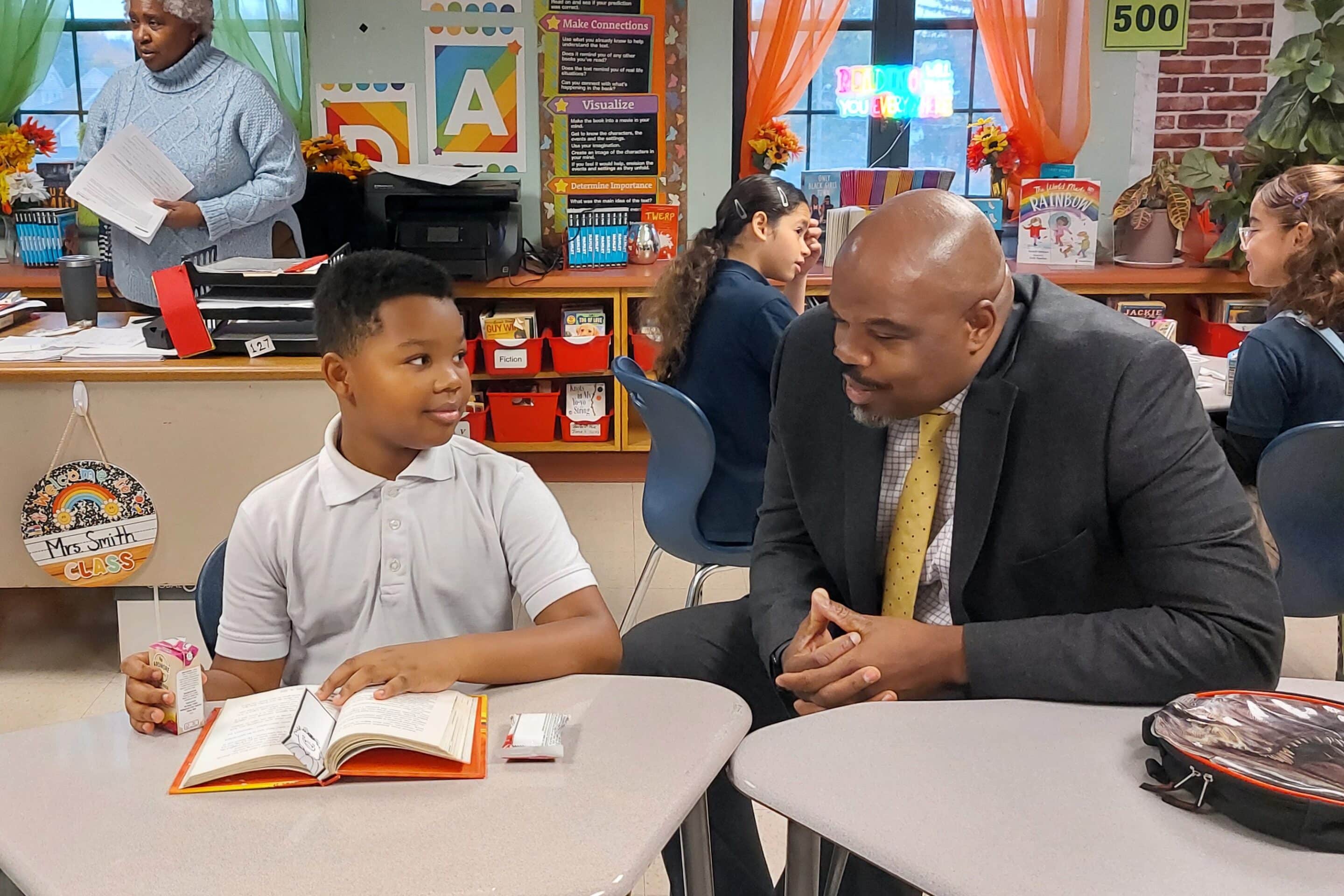
Massachusetts Education Secretary Patrick Tutwiler talks with Kameron Hillman while he has breakfast and reads a book.
Reminder Publishing photo by Sarah Heinonen
SPRINGFIELD — It was 8:30 a.m., the start of another school day. Children filed into their classrooms at Rebecca M. Johnson School.
The students found their seats, set down their belongings and walked over to the corner of the room where a table sat covered with large, insulated bags. It was breakfast time.
Since 2015, every school in Springfield has participated in the Breakfast in the Classroom program, an opportunity for students to have their first meal of the day, not in the cafeteria, but at their desks. Now, the state has recognized Springfield’s program as a model for the rest of the state.
Secretary of Education Patrick Tutwiler visited Rebecca Johnson School on Nov. 10 to see the program in action, before touring the Culinary and Nutrition Center where the food is made.
Each day, food is brought into the classrooms. Students can choose from a variety of foods, but must have at least three items, one of which is fruit or juice. Andrew Stratton, general manager of Home Grown Springfield, the culinary and nutrition program for Springfield Public Schools, said students can choose from cereal or hot entrees, like breakfast sandwiches or pockets. Each insulated bag is marked with a specific classroom to ensure students with dietary or cultural restrictions have options they can eat. He added that they are working on creating a hallal-safe egg dish.
Principal Chris Sutton explained that having breakfast in the classroom allows students time to ease into their day, socialize with friends and talk to their teachers. Springfield Public Schools Superintendent Sonia Dinnall pointed to the books open on students’ desks and said, “We incorporated the learning during breakfast time.” Students discuss the books they are reading while they eat. “It makes it a joyful, nice, pleasant environment, almost like a family feel in the classroom. The feeling that students have of belonging is critical.”
Noah Ouinones ate a bowl of cereal while reading a book titled, “The One and Only Ivan.” Asked what he likes to have for breakfast, he said, “It depends what they have. If they have the pockets, I’ll usually get the pockets. If not, I’ll get cereal.” He said that he mostly enjoyed eating in the classroom because he had time to read. Jayzier Bermudez also said he likes having time to eat before class. He particularly likes the chocolate muffins, he said.
The meals are free to students and paid for through a combination of federal funds from the Department of Agriculture and the state, which has provided for universal school meals since 2023.
According to Eos Foundation, a private philanthropic entity that provides grants to begin Breakfast in the Classroom programs, “Just 48% of students enrolled in the commonwealth’s high-poverty K-12 schools receive free breakfast, even though the program is open to all students. By failing to serve at least 80% of students breakfast, the state cannot access more than $70 million in reimbursements from the U.S. Department of Agriculture.” In fall 2024, 292,000 students across the state ate breakfast daily, half as many as have school lunch.
In Springfield, data from May shows that 84% of students eat breakfast at school. Eos Foundation President Andrea Silbert said the program makes it “seamless” to ensure children have breakfast. She also said the program has contributed to a reduction in tardies and absences. The Eos Foundation is launching a three-year campaign to bring the program to the rest of the state, she said.
Culinary and Nutrition Center
Reminder Publishing photo by Sarah Heinonen
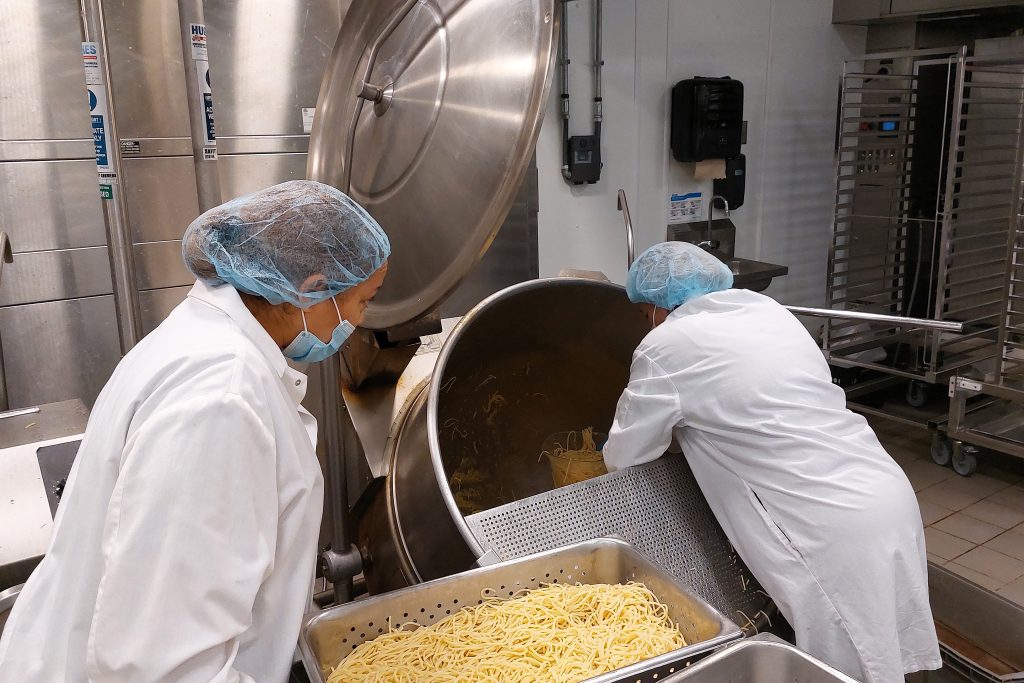
At the Culinary and Nutrition Center, a 62,000-square-foot full-service commercial kitchen on Cadwell Drive, herbs are added to enormous stainless-steel kettles full of marinara sauce. Stratton explained that, once the sauce and pasta are combined, the meal with be “flash chilled” for transport to the schools.
In another room, filled with the aroma of maple, a mixture of ingredients is being pumped from an oversized bowl into a machine that squirts it into muffin tins. After baking in large vertical ovens, the muffins are individually packaged. The facility makes batches of 18,000 muffins each day.
“Amazing,” Tutwiler remarked.
Pointing out the meat room, Lydia Rodriguez, director of operations and communication at Sodexo, which partners with Home Grown Springfield to provide the meals, said that, by making the sausage patties and meatballs from scratch, they were able to reduce the amount of salt and fat they contained.
Since opening in 2019 with funds from increased breakfast reimbursement revenue, the facility has prepared more than 50 million meals for the district.
Stratton said many of the ingredients that go into school meals are sourced locally, from Massachusetts-grown tomatoes to Cape Cod fish, flour from Quincy and corn tortillas from right in Springfield.
The facility also looks locally when composting its food waste. It is sent to the Vanguard Renewables facility in Agawam, which turns it into fertilizer used on many of the farms that grow food for Home Grown Springfield.
“We’re all extremely passionate,” about the mission to “never leave a student hungry,” Rodriguez said.

- Sarah Heinonen
- Sarah Heinonen
- Sarah Heinonen
- Sarah Heinonen
- Sarah Heinonen
- Sarah Heinonen
- Sarah Heinonen
- Sarah Heinonen
- Sarah Heinonen
- Sarah Heinonen
- Sarah Heinonen
- Sarah Heinonen
- Sarah Heinonen
- Sarah Heinonen
- Sarah Heinonen
- Sarah Heinonen
- Sarah Heinonen
- Sarah Heinonen
- Sarah Heinonen
- Sarah Heinonen
- Sarah Heinonen
- Sarah Heinonen
- Sarah Heinonen
- Sarah Heinonen
- Sarah Heinonen
- Sarah Heinonen
- Sarah Heinonen
- Sarah Heinonen
- Sarah Heinonen
- Sarah Heinonen
- Sarah Heinonen
- Sarah Heinonen
- Sarah Heinonen
- Sarah Heinonen
- Sarah Heinonen
- Sarah Heinonen
- Sarah Heinonen
- Sarah Heinonen
- Sarah Heinonen
- Sarah Heinonen
- Sarah Heinonen
- Sarah Heinonen
- Sarah Heinonen
- Sarah Heinonen
- Sarah Heinonen
- Sarah Heinonen
- Sarah Heinonen
- Sarah Heinonen
- Sarah Heinonen
- Sarah Heinonen
- Sarah Heinonen
- Sarah Heinonen
- Sarah Heinonen
- Sarah Heinonen
- Sarah Heinonen
- Sarah Heinonen
- Sarah Heinonen
- Sarah Heinonen
- Sarah Heinonen
- Sarah Heinonen
- Sarah Heinonen
- Sarah Heinonen
- Sarah Heinonen
- Sarah Heinonen
- Sarah Heinonen
- Sarah Heinonen
- Sarah Heinonen
- Sarah Heinonen
- Sarah Heinonen
- Sarah Heinonen
- Sarah Heinonen
- Sarah Heinonen
- Sarah Heinonen
- Sarah Heinonen
- Sarah Heinonen
- Sarah Heinonen
- Sarah Heinonen
- Sarah Heinonen
- Sarah Heinonen
- Sarah Heinonen
- Sarah Heinonen
- Sarah Heinonen
- Sarah Heinonen
- Sarah Heinonen
- Sarah Heinonen
- Sarah Heinonen
- Sarah Heinonen
- Sarah Heinonen
- Sarah Heinonen
- Sarah Heinonen
- Sarah Heinonen
- Sarah Heinonen
- Sarah Heinonen
- Sarah Heinonen
- Sarah Heinonen
- Sarah Heinonen
- Sarah Heinonen
- Sarah Heinonen
- Sarah Heinonen
- Sarah Heinonen
- Sarah Heinonen
- Sarah Heinonen
- Sarah Heinonen
- Sarah Heinonen
- Sarah Heinonen
- Sarah Heinonen
- Sarah Heinonen
- Sarah Heinonen
- Sarah Heinonen
- Sarah Heinonen
- Sarah Heinonen
- Sarah Heinonen
- Sarah Heinonen
- Sarah Heinonen
- Sarah Heinonen
- Sarah Heinonen
- Sarah Heinonen
- Sarah Heinonen
- Sarah Heinonen
- Sarah Heinonen
- Sarah Heinonen
- Sarah Heinonen
- Sarah Heinonen
- Sarah Heinonen
- Sarah Heinonen
- Sarah Heinonen
- Sarah Heinonen
- Sarah Heinonen
- Sarah Heinonen
- Sarah Heinonen
- Sarah Heinonen
- Sarah Heinonen
- Sarah Heinonen
- Sarah Heinonen
- Sarah Heinonen
- Sarah Heinonen
- Sarah Heinonen
- Sarah Heinonen
- Sarah Heinonen
- Sarah Heinonen
- Sarah Heinonen
- Sarah Heinonen
- Sarah Heinonen
- Sarah Heinonen
- Sarah Heinonen
- Sarah Heinonen
- Sarah Heinonen
- Sarah Heinonen
- Sarah Heinonen
- Sarah Heinonen
- Sarah Heinonen
- Sarah Heinonen
- Sarah Heinonen
You must be logged in to post a comment.