
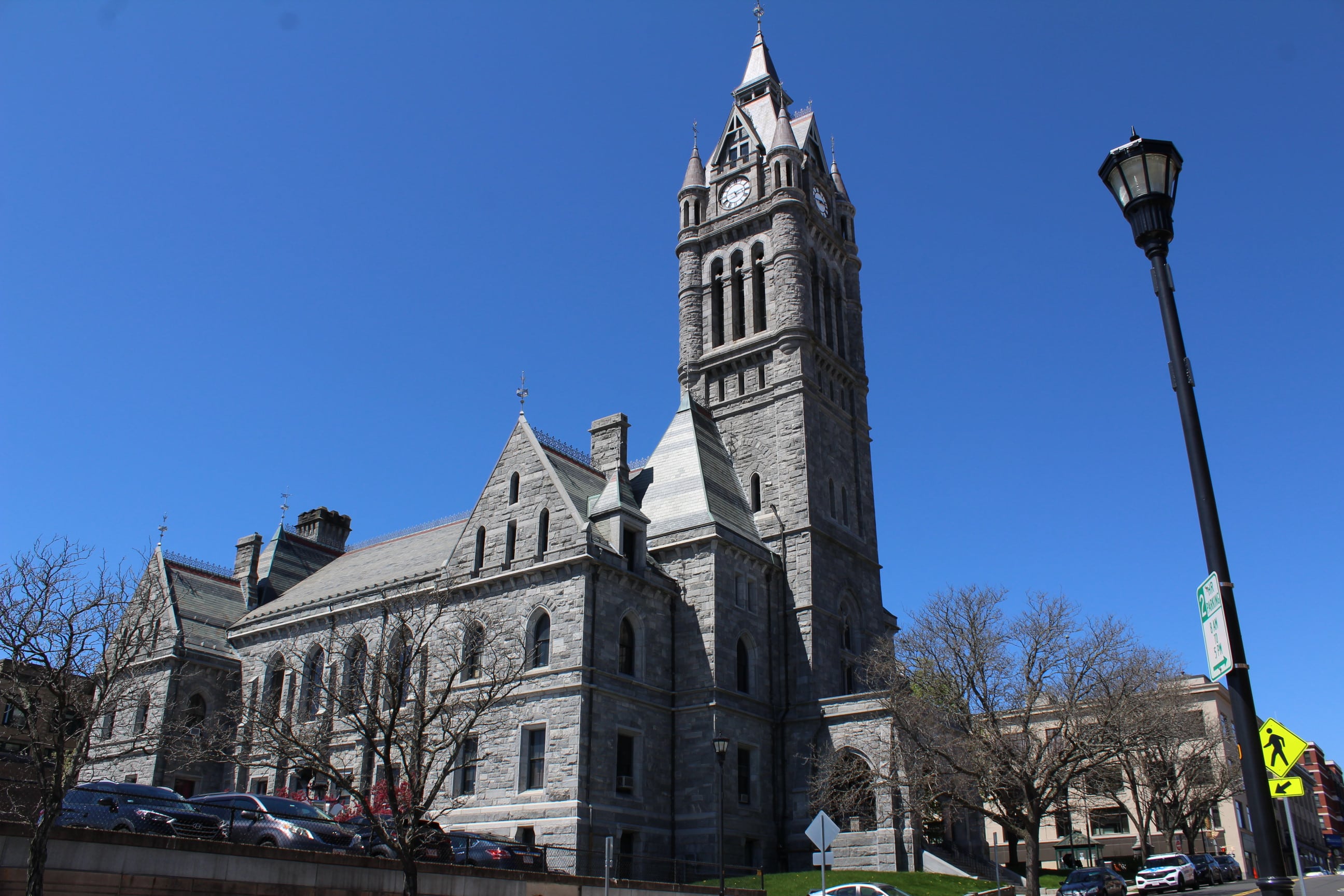
Residences at Appleton’s exterior main entry.
Reminder Publishing submitted photo
HOLYOKE — WinnCompanies recently announced the completion of a $55.3 million adaptive reuse that transformed a long-vacant, historic mill complex into 88 affordable apartment homes for seniors ages 55 and older.
The downtown Holyoke project created Residences on Appleton, featuring new loft-style apartments within three interconnected, 111-year-old industrial buildings that had been vacant for decades.
The community reached full occupancy in December, less than three months after it opened.
WinnDevelopmnent President Adam Stein talked about his company’s project in Holyoke, saying, “This effort preserved an iconic feature of Holyoke’s proud industrial legacy, created much-needed housing for seniors who want to stay in the community they love, and provided an economic boost to the city’s downtown.”
Stein also added that WinnDevelopment will begin work soon on a second phase that will deliver 75 additional apartments in an adjacent part of the complex.
All 88 apartments are reserved for low- and moderate-income seniors, with 12 units reserved for households below 30 percent of Area Median Income, 63 for those below 60 percent of AMI and 13 for households below 80 percent of AMI.
Eight of the units are available to eligible households through the U.S. Department of Housing and Urban Development’s Project Based Voucher program. Five units are set aside for Massachusetts Department of Mental Health clients through the Facilities Consolidation Fund.
“The restoration and reuse of the old alpaca mill building is a very encouraging demonstration of what can be accomplished when an ambitious vision is supported by a well-crafted public-private collaboration,” Mayor Joshua Garcia said of the project. “Residences on Appleton is a testament to our caring and respect for Holyoke’s seniors. The city’s partnership with the WinnCompanies has brought about a model development that will continue to inspire private entrepreneurs to work with municipal leaders.”
Residences on Appleton offers four studio, 75 one-bedroom and nine two-bedroom apartments. Resident amenity spaces include on-site management offices, a fitness center, a resident lounge, an outdoor recreation area along the adjacent canal, laundry facilities and 109 parking spaces.
A new construction community building that was built as part of the project is connected to the residential space via a closed skybridge spanning nearby railroad tracks.
Designed to meet the sustainability criteria of Enterprise Green Communities, the Residences on Appleton is 100 percent electric, powered by the Holyoke’s clean hydropower system.
It also features LED lighting, Energy Star appliances, low-flow, water-conserving plumbing fixtures and premium roof insulation.
WinnResidential, the property management arm of WinnCompanies, provides day-to-day operations for the community.
Holyoke’s former Office of Planning and Economic Development Director Aaron Vega talked about the significance of partnership with WinnDevelopment in helping achieve Holyoke’s goals.
“Working with WinnDevelopment through this process to bring new housing units and save this historic mill building has been a labor of love. The HRA partnership with Winn is another example of a private-public partnership that brings results,” Vega said. “This project is key to our downtown revitalization efforts. Business growth, tourism, public safety and increasing the population of Holyoke are all tied to having quality housing stock available.”
Once the largest alpaca wool mill in the world, the brick mill complex is one of Holyoke’s most prominent historic properties and is located across the street from a state park dedicated to showcasing Holyoke’s industrial and cultural heritage. The complex has been largely vacant since the 1970s and has been a priority for redevelopment since the city of Holyoke took title to the property 12 years ago.
The adaptive reuse overseen by WinnDevelopment focused on an 86,000-square-foot section of the complex that includes three structures: Building 4, erected in 1880 and the oldest on the site; Building 5, a storage, washing and sorting facility erected in 1905; and Building 6, also built in 1905 and the largest structure on the property.

- Tyler Garnet
- Tyler Garnet
- Tyler Garnet
- Tyler Garnet
- Tyler Garnet
- Tyler Garnet
- Tyler Garnet
- Tyler Garnet
- Tyler Garnet
- Tyler Garnet
- Tyler Garnet
- Tyler Garnet
- Tyler Garnet
- Tyler Garnet
- Tyler Garnet
- Tyler Garnet
- Tyler Garnet
- Tyler Garnet
- Tyler Garnet
- Tyler Garnet
- Tyler Garnet
- Tyler Garnet
- Tyler Garnet
- Tyler Garnet
- Tyler Garnet
- Tyler Garnet
- Tyler Garnet
- Tyler Garnet
- Tyler Garnet
- Tyler Garnet
- Tyler Garnet
- Tyler Garnet
- Tyler Garnet
- Tyler Garnet
- Tyler Garnet
- Tyler Garnet
- Tyler Garnet
- Tyler Garnet
- Tyler Garnet
- Tyler Garnet
- Tyler Garnet
- Tyler Garnet
- Tyler Garnet
- Tyler Garnet
- Tyler Garnet
- Tyler Garnet
- Tyler Garnet
- Tyler Garnet
- Tyler Garnet
- Tyler Garnet
- Tyler Garnet
- Tyler Garnet
- Tyler Garnet
- Tyler Garnet
- Tyler Garnet
- Tyler Garnet
- Tyler Garnet
- Tyler Garnet
- Tyler Garnet
- Tyler Garnet
- Tyler Garnet
- Tyler Garnet
- Tyler Garnet
- Tyler Garnet
- Tyler Garnet
- Tyler Garnet
- Tyler Garnet
- Tyler Garnet
- Tyler Garnet
- Tyler Garnet
- Tyler Garnet
- Tyler Garnet
- Tyler Garnet
- Tyler Garnet
- Tyler Garnet
- Tyler Garnet
- Tyler Garnet
- Tyler Garnet
- Tyler Garnet
- Tyler Garnet
- Tyler Garnet
- Tyler Garnet
- Tyler Garnet
- Tyler Garnet