
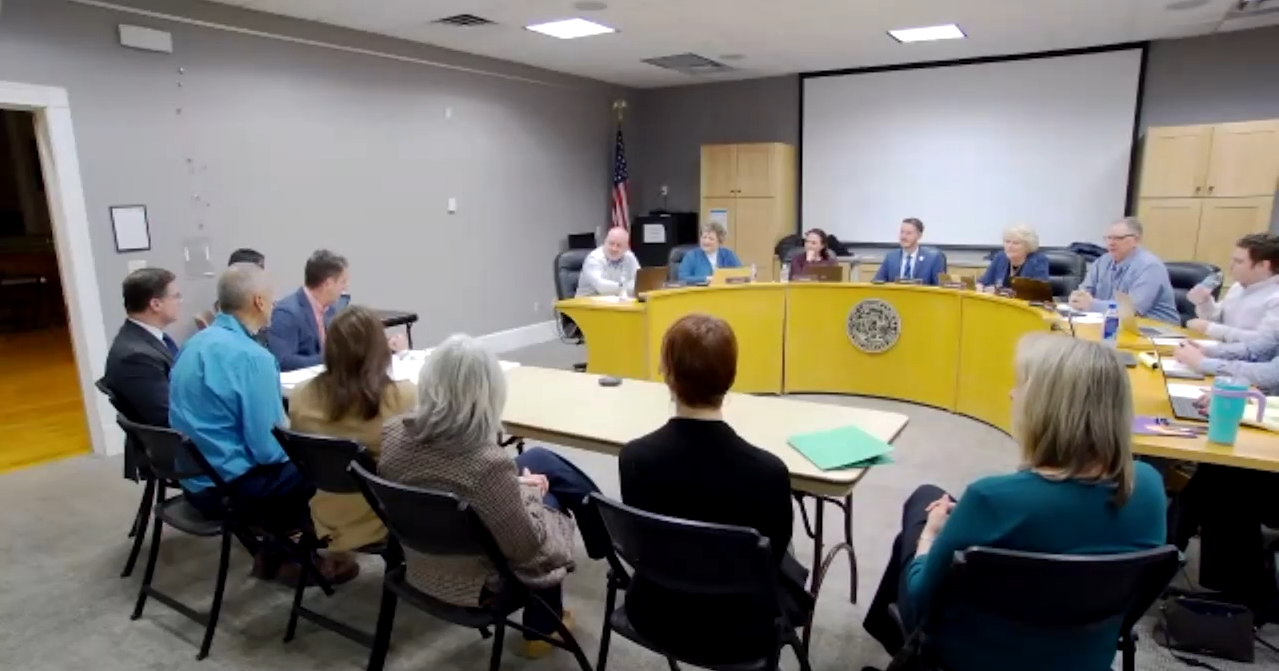
The East Longmeadow School Committee meets with the Town Council on Jan. 13./
Photo credit: ELCAT
EAST LONGMEADOW — The East Longmeadow School Committee joined the Town Council to discuss the fiscal year 2027 budget in a joint meeting on Jan. 13.
Town Manager Tom Christensen began the discussion and said that the operating budget has not been nailed down yet, but some aspects are expected to increase, such as a 15% uptick in health insurance, 9% for retirement and $100,000 for the new high school’s insurance.
Christensen also said to expect a large increase in the high school’s electric bill due to the building being all electric. The building is set for photovoltaic solar energy and he said that he hopes it offsets some of the increase. An estimated cost is $1.3 million for installation, with $1 million due upfront in July 2026 and the rest after completion.
School Committee Chair Greg Thompson said working with the town manager has been fantastic and that working collaboratively on the new school has been moving fantastically and on time.
“It is beautiful,” Thompson said. “It will be an asset to this community and we’re hopeful that folks will get in and get a chance to look at it.”
Thompson also said that he’s hopeful they’ll get to work with the recreation department to make the pool accessible to the community. It will be blocked off from the school and will have designated parking.
“We’re hoping to use that pool, as we said we would, as a community based program for the whole town,” Thompson said.
Thompson also said two additional classrooms at Mountain View are underway. The framing is complete and just needs to be closed in. He said he hopes those will be online by the end of the school year, or at least the next school year.
“We will have all the building space we are going to have for a while,” Thompson said. “We will be opening the new building, as you all know, next fall in August.”
Thompson also provided an update with staffing and said that they are down 20 full time positions from last year. In FY25, over 470 positions were funded and in FY26, there are only 454. He said they used $350,000 from the School Choice account, as discussed, and that there won’t be that much to use next year. There is a balance that will hopefully supplement the operating budget because it is a source of income, Thompson said.
To follow up Christensen’s point on solar energy, Thompson said they hope to significantly offset a quarter of the increase in gas and electricity, leaving an estimated $250,000 increase.
“I think that may be conservative, but we won’t know until the first year, so we’ll have a good year to run through it,” Thompson said. “The architects and the builders tell us it’s gonna be about an additional year before we get the solar panels online, so we’ll see that increase for one year and we’ll realize the savings from the solar panels the second year, so this is like a two year process.”
Thompson said they knew there would be a rise in electric costs and a substantial increase in the budget due to the new building being all electric.
Council President Connor O’Shea said from a council perspective, they’re still evaluating priorities as the budget process continues, but that they definitely have an interest in keeping things at the services they’re offering and maintaining the standards they have as a community.
“It’s a good start but more to come of course as the numbers firm up,” O’Shea said.
Assistant Superintendent for Business Pamela Blair said she worries about fitting everything back into the budget and completing the contract negotiations among different percentages and steps of staff salaries. She said $80,000 has been cut from curriculum renewal and they’re using $450,000 from School Choice but won’t have that same revenue next year. Instead, $283,000 is projected for next year at $5,000 per student.
“It’s a balancing act trying to get these things back into the operating budget,” Blair said.
Superintendent Gordon Smith said the numbers will be set in a clearer display once they receive the Chapter 70 budget numbers from Gov. Maura Healey. He said it’s hard to know where the number will go but they’re always hopeful. One thing they are not in control of is the increases in transportation, which Smith said doesn’t get talked about enough.
“When you look at transportation costs from FY24 to FY25, transportation as a whole, that’s regular transportation and special ed transportation, went up 9.54%,” Smith said. “Transportation between FY25 and FY26 went up 5.54%, so when you look at increases, either from Chapter 70 or from the town, and I’m not saying the town could have done more, we’re just not keeping up.”
Christensen said that those conversations will continue at the state level because it’s a problem plaguing every school district in the commonwealth.
“It’s like us trying to keep up, right with our 4, 5% budget increase with Prop. 2 ½ . You don’t need to be a mathematician to know that’s not going to work out,” Christensen said. “The state sort of needs to start funding these things at a more appropriate level.”
Blair also said that the students are changing, especially since the COVID-19 pandemic and Assistant Superintendent for Teaching and Learning Heather Brown said there are a lot more needs for students and staff and for resources to support that.
“Of course our goal is to make sure all students are getting what they need to thrive,” Brown said. “There’s also extra demands from the state that we purchase high quality instructional materials, so that requires a year to year increase, in terms of what we’re purchasing.”
Smith added on to Brown’s point by saying that goes for every student as well for the past decade. He said the students in front of them do not learn the same way as students from five to 10 years ago did.
“You do need to stay with consistent professional development,” Smith said. “When you’re cutting back on that, you’re also then putting ourselves into a really challenging situation, okay, how do we get our staff the skill development that they need to continue to produce at a high level with students”
O’Shea said that this was a good kickoff to the process, but once the department budgets are submitted, they’ll have a better idea of where things are looking from a town perspective.