
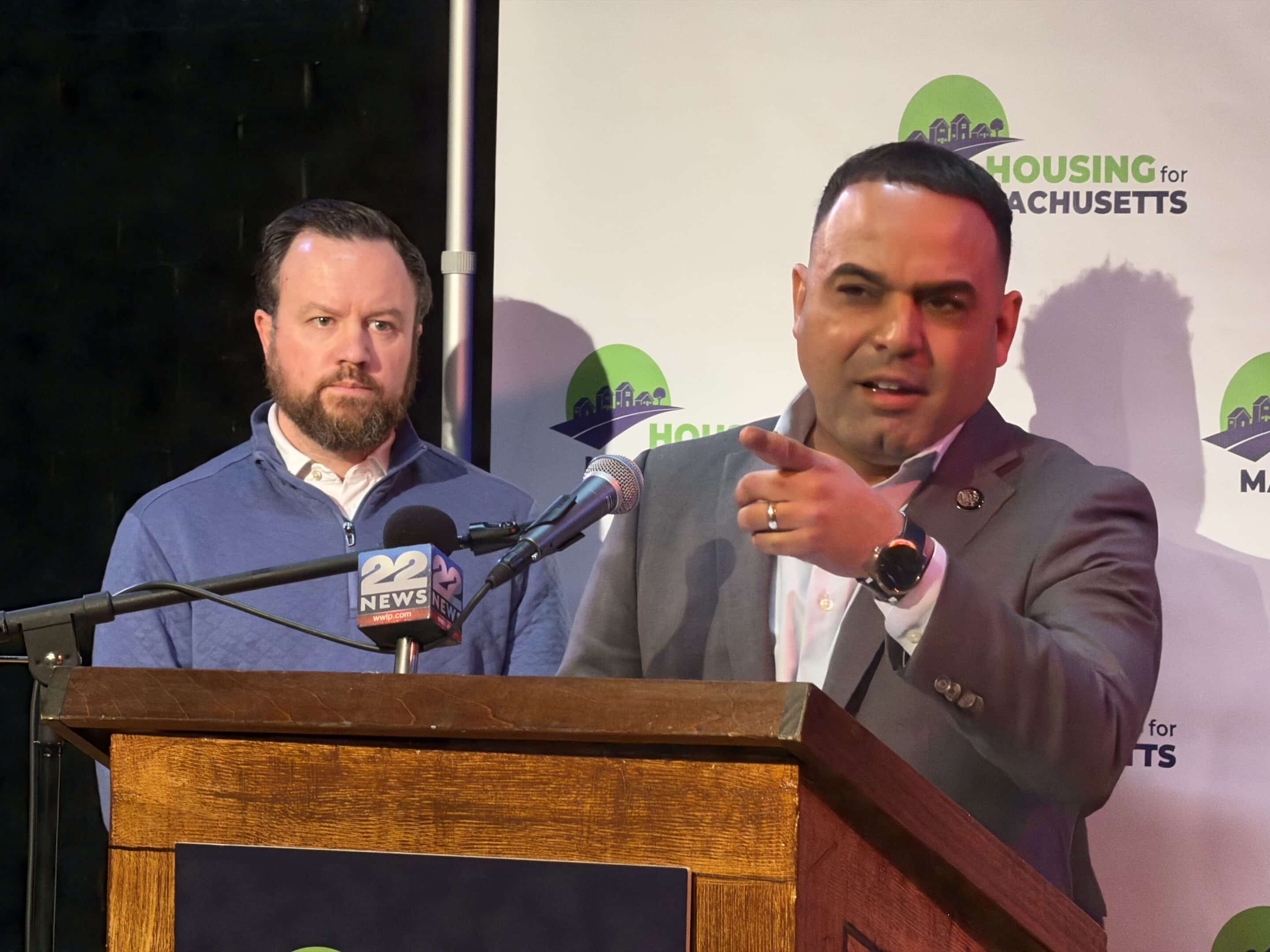
Holyoke Mayor Joshua Garcia said while this ballot question was well-intentioned, this is an issue that needs a different approach than this initiative.
Reminder Publishing photo by Trent Levakis
HOLYOKE — Lighthouse Holyoke’s Divine Theater was the site for a Feb. 25 press conference hosted by leaders from Holyoke and Springfield to share their opinions about the rent control initiative that looms across the state this year.
The conference was led by Housing for Massachusetts, a broad coalition of state residents, small property owners, family-owned real estate companies, affordable housing developers, housing advocates, and business leaders concerned about the housing affordability and availability across the state.
Holyoke Mayor Joshua Garcia, Springfield City Councilor Mike Fenton, small property owners and Pioneer Valley Developers joined the event to speak out against the proposed rent control ballot question and highlight unintended consequences from the statewide proposal.
The current state ballot initiative proposes a cap on annual residential rent increases at 5%, or by the Consumer Price Index, whichever is lower. If passed, the policy would repeal a law passed by Massachusetts voters in 1994 to ban rent control and would apply to virtually all privately owned rental housing across the Pioneer Valley that is not owner-occupied, a point expressed repeatedly by speakers during the press conference.
Members of Springfield No One Leaves and other local protesters attended in response to the campaign, arguing the ballot question is one of the few protections available for tenants facing drastic increases in rent. According to a recent Bay State Poll conducted by the University of New Hampshire Survey Center, 56% of respondents either somewhat or strongly support the proposed ballot question.
In December, Gov. Maura Healey told Boston Public Radio she was against the initiative and said that rent control was not going to solve the state’s housing affordability crisis, arguing that the current proposal would “effectively halt production.” Healey also noted then that she noticed that investors in housing are already pulling out of the state with concerns about the looming ballot question.
During the conference, Chair of Housing for Massachusetts Conor Yunits explained that while the initiative was well-intentioned, it was not a solution to the state’s housing crisis. Instead, he argued that in order to really start combating the issue, the state simply needs to develop more housing.

Chair of Housing for Massachusetts Conor Yunits explained that while the initiative was well intentioned, it was not a solution to the state’s housing crisis.
Reminder Publishing photo by Trent Levakis
“Everyone here is concerned about housing. We know there is an affordability crisis, and that’s why many of us have been working with the governor, with the Legislature, with mayors, city councilors and policy leaders for years, to build more housing. Because when you look around the country, and you see where housing prices are falling, like in Austin, Texas, where rents are down 6%, or in Phoenix, where rents are down 4%, it’s because they are building housing,” said Yunits. “They have more supply than demand. Here, we have significantly more demand than we have supply. Cities and states that build new quality housing see prices fall.”
Yunits also pointed out that the cap of rental rate increases does not include any exceptions for building renovations and no appeal process for property owners to recover costs for upgrades or improvements. He noted that if increases could only match the rate of inflation, as measured by the consumer price index, most rent increases would fall well below the 5% cap, based on the average 2.6% seen over the last 20 years in inflation.
“We all know that we need to pick up the pace of housing creation, and that’s why we all support solutions that remove barriers to affordable and market rate housing, and [we] would welcome new ideas that spark construction. But we also know that any policy that constricts supply will take us backwards, and that’s what this ballot question will do,” added Yunits.
Yunits said similar efforts for rent control across the country have yielded negative consequences. Proponents of the measure have said, “this is not your father’s rent control,” to which Yunits said that is correct; it is a worse policy.
“This question, with some minor exemptions, will apply to every single residential dwelling unit that is rented out in Massachusetts. Not just every apartment building, not just housing in every city, every single residential dwelling unit in every community in Massachusetts,” Yunits said.
He shared that the measure would leave landlords unable to cover rising costs of upkeep and would give no incentive for a property owner to manage or invest, and that these issues could also lead to an eroded local tax base from reduced property values.
“And what happens when rents are capped? The value of the property is also capped. Then the property tax revenue that the property generates for the local community is also capped,” said Yunits.
Garcia added similar sentiments, saying that rent control would only discourage rent development, something a Gateway City like Holyoke cannot afford.
“We face big city challenges with small town revenue,” said Garcia, adding the city relies heavily on responsible private investment to rebuild neighborhoods and expand its tax base. “Development slows, revenue slows, and that limits our ability to invest in public spaces, infrastructure and our schools.”
Garcia shared that Holyoke is number one in the state when it comes to housing stock per capita dedicated to affordable housing.
He highlighted one protester standing in the back of the room with a sign saying, “The Rent is Wicked High.” Garcia said it was a statement that he agrees with and that there are dramatic rent increases in communities all over the commonwealth, but while this ballot question was well-intended, he argued that there needs to be a different approach.
“The real question for me comes down to how do we work together to establish better rent control, and the real answer is not as simple as it sounds, but it is what it is: we do need more housing development here in our community and across the commonwealth,” said Garcia. “Families, they’re all feeling the pressure [from the housing crisis] across the spectrum, and we must acknowledge that reality no question. But this issue is a rather complex one.”
Garcia added that the pressures may be shared, but the conditions for each community vary.
“We need thoughtful, balanced solutions, not policies that are risky for communities already working hard to rebuild, and I’m talking in particular about gateway cities like Holyoke,” said Garcia. “There’s no guarantee that a rent-controlled unit would go to a low-income family or our most vulnerable residents. And this just kind of speaks to when I say there’s always unintended consequences.”
Springfield City Councilor Mike Fenton said Western Massachusetts has an affordability crisis. He argued that the idea of rent control is an admirable one, but the problem with the referendum was in the nuances of the details.
“For cities like Springfield, we’re trying to grow and maintain our market rate housing. We can’t afford uncertainty and discouragement of investment in housing,” Fenton said. “There’s nothing in this proposal that incentivizes property owners to reinvest in the maintenance and repairs of their homes. We can all agree that we need solutions to the housing crisis, but this proposal will not solve it.”
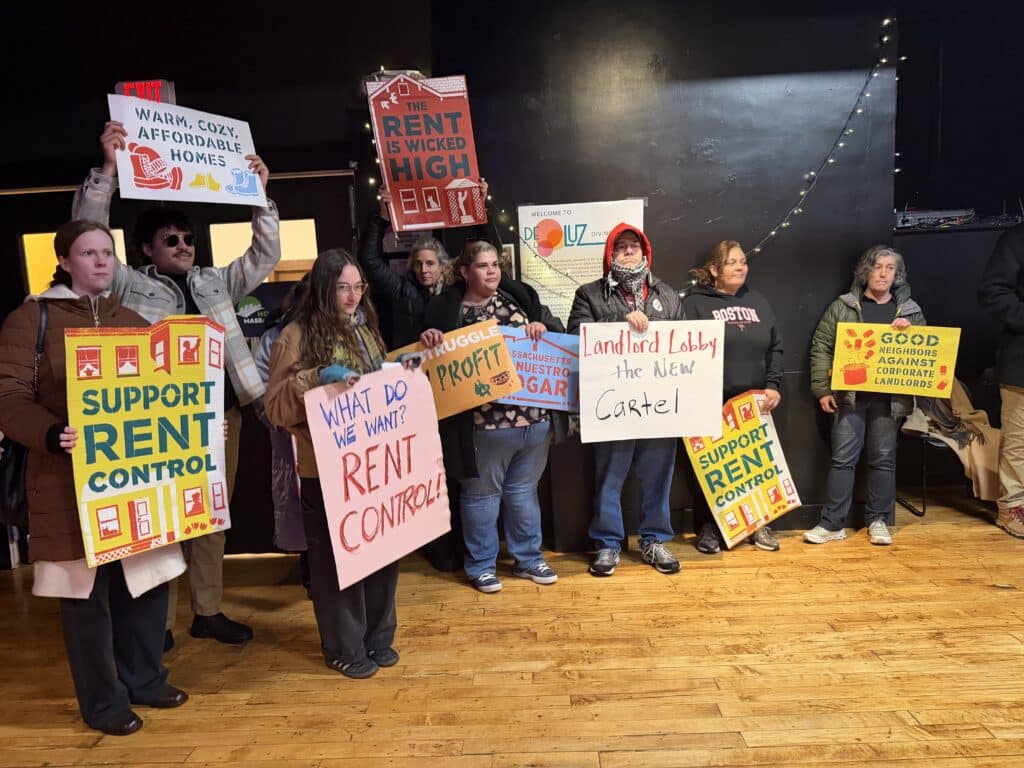
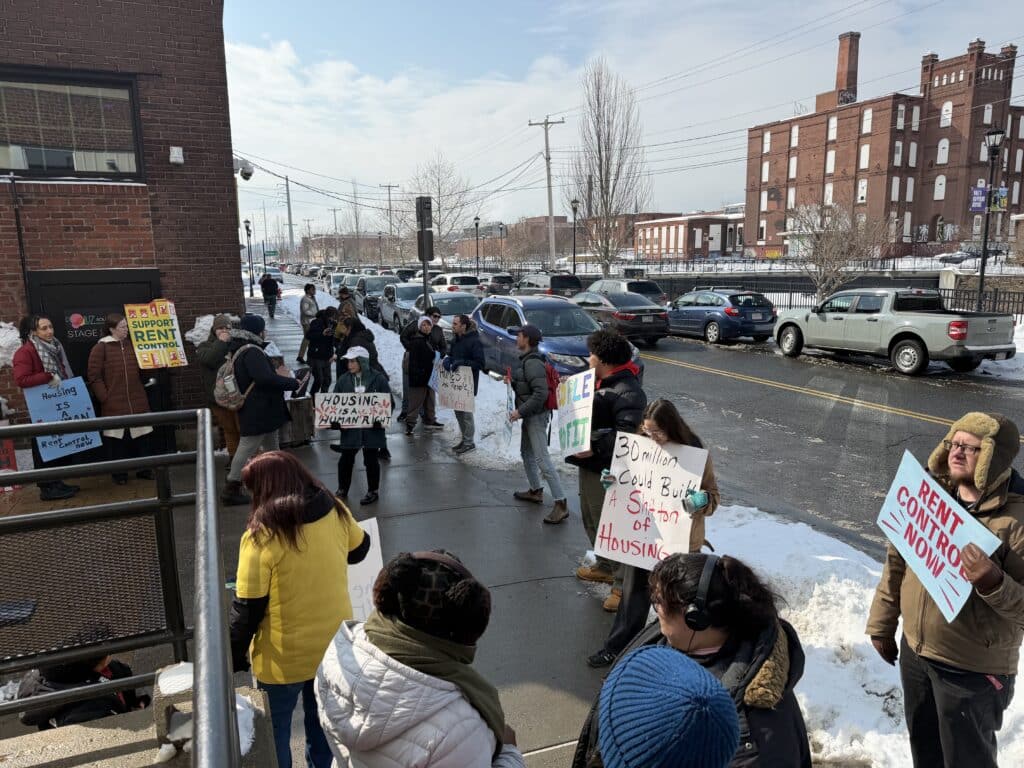
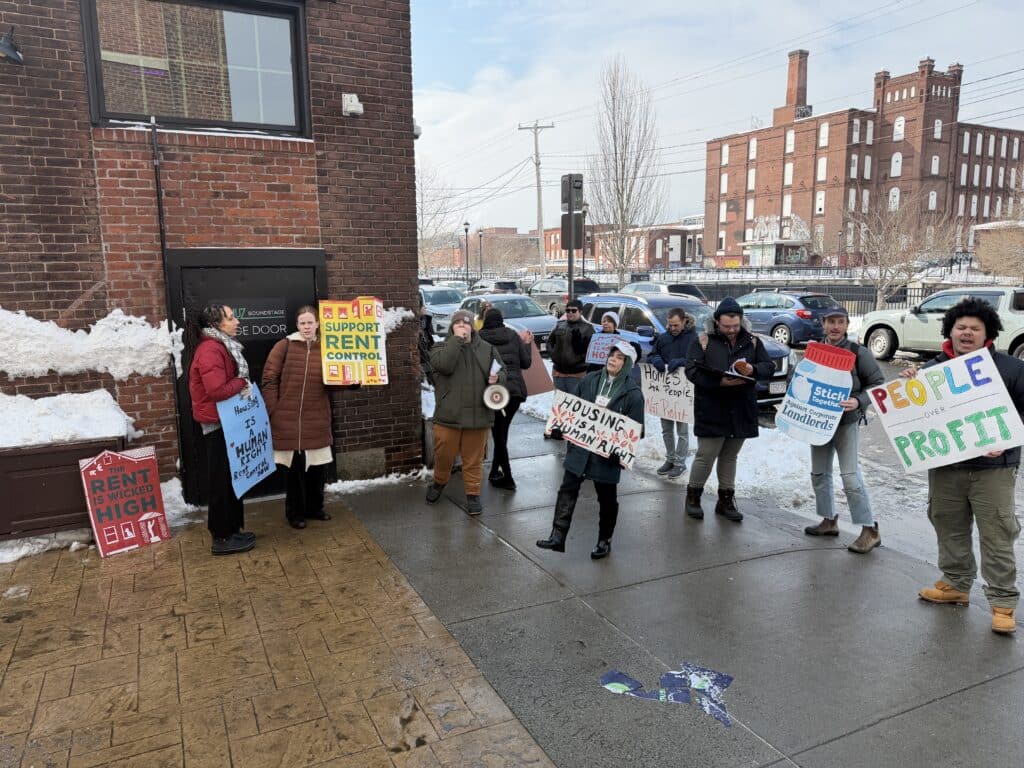
Protesters gathered during the press conference at Lighthouse Holyoke in opposition to the anti-rent control campaign.
Reminder Publishing photos by Trent Levakis
Despite this opposition, not everyone at the press conference was against the measure. Katie Talbot, an organizer with Springfield No One Leaves, told Reminder Publishing the rent control measure is needed because it serves as a “tourniquet” for the larger housing crisis.
“Our larger housing crisis stems from the ability of corporate and LLC landlords to make egregious profit. That’s where it stems from; when we started allowing corporations and companies to buy out homes and make a profit off it, things shifted,” said Talbot. “I don’t think rent control is the say-all, be-all, end-all of the housing crisis. It’s not. But it allows our people to stop hemorrhaging money, to actually be able to adjust to a reasonable rent increase annually, and it also keeps our people in our communities.”
Talbot said that, while working with Springfield No One Leaves, she has heard from various tenants that they have had to move out of their communities after facing large increases in monthly rent from landlords. She said that she feels there is a disconnect from those who don’t understand what it’s like to rent in the current landscape.
“I think there’s a real out-of-touch analysis from the opponents of rent control. None of them on that stage are renters; none of them have been renters for a long time. So, I think there are a lot of folks that are pushing back against rent control that really don’t know what it’s like to be a renter these days,” said Talbot.
Talbot said it has been encouraging to see the passage of the Affordable Homes Act last year and some investments made by the state into municipal housing. She argued that more effort should be made in these areas alongside the rent control initiative.
“Tenants need it. Homeowners are identifying the need for rent control because they’re having their adult children move back home because of rent increases. We’re seeing across the country home ownership is not happening until people are 40, and that’s because they can’t save money because of rent,” said Talbot. “The folks that are opposed to it are the landlord lobby, the developer lobby and the real estate lobby, who all profit off housing, so I think it’s just a very telling and a very stark difference.”

You must be logged in to post a comment.