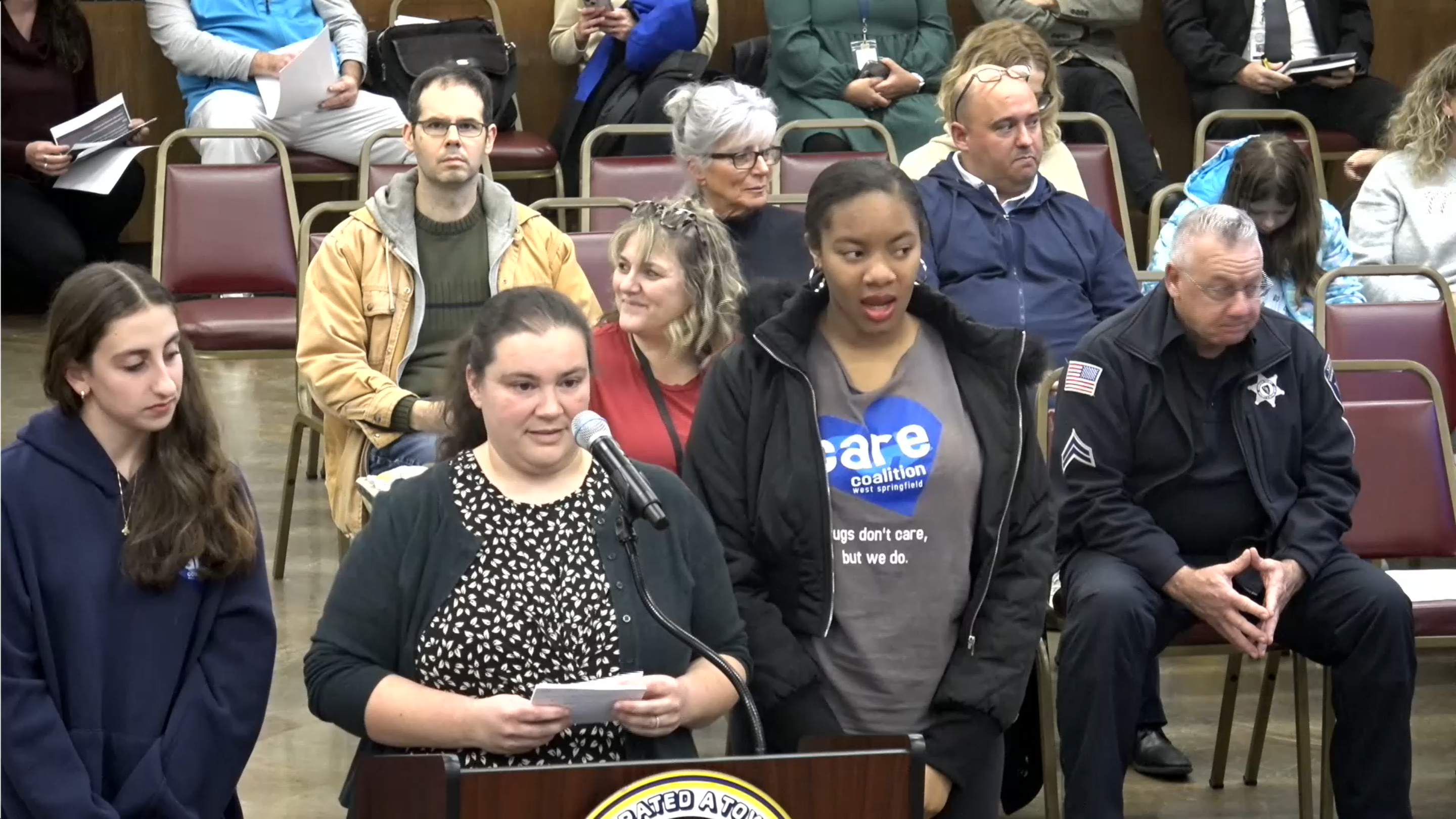
Members of West Springfield’s CARE Coalition speak to the West Springfield School Committee on Dec. 9.
Photo credit: West Springfield Access
WEST SPRINGFIELD — Liz Monopoli from the town of West Springfield’s CARE Coalition presented its biannual Prevention Needs Assessment at the West Springfield School Committee meeting on Dec. 9.
The CARE Coalition is a group that works to strengthen community capacity to support positive youth development and reduce risky behavior. It collaborates with schools, police and other organizations with a youth voice at the center of prevention work.
The PNA is a survey among students in grades 8, 10 and 12 in West Springfield schools. The goal is to identify substance use trends and identify risk and protective factors to guide local prevention priorities.
“Early initiation increases risk for addiction and other problems, which is why it’s really important to focus on grade 8, 10 and 12. because they’re still in our school systems,” Monopoli said.
Monopoli’s presentation compared results from the past six years, dating back to 2019, on students’ alcohol, cigarette, vaping and marijuana use, and perceptions surrounding substance use. Four hundred sixty eight students across the three grades responded to the survey anonymously and voluntarily.
“It’s crucial because local problems require local solutions,” Monopoli said. “Data helps us precisely identify where risks lie and what protective factors we can strengthen to guide our efforts.”
The survey questioned students’ lifetime use, as well as substance use within the last 30 days, and compared the results with previous PNAs. For if they’ve ever used a substance in their lifetimes, 21.8% of students have drank alcohol, 17.8% have vaped, 14.6% have used marijuna and 9.8% have smoked a cigarette.
Substance abuse trends among WSHS students were compared from 2021, 2023 and 2025. Monopoli said the 30 day results help identify where to target prevention and show students who may be developing regular use patterns.
“We see here a significant decrease in alcohol since 2021 and a concerning uptick in vape use in 2025 vs. 2023,” Monopoli said. “Marijuana use remains relatively flat but is still a concern.”
Monopoli noted alcohol is often the first substance that the youth try. 12.2% of students reported using a vape in the past 30 days, compared to the 8.3% in 2023 and 8.9% in 2021. There was also a slight uptick in cigarette use in 2025, at 1.8% compared to the 1% in 2023.
Vaping in eighth grade has nearly quadrupled since 2021, going from just 3% to 10.9%. With seniors being closest to legally using the products, the 30 day use for each alcohol, vaping and marijuana are significantly higher than the other grades, but have decreased since 2019.
Monopoli said when perception of substance use risk is lower, the use is way higher. The lowest perception of risk is for marijuana use once or twice a week at 50%. The survey also asked “how wrong do your friends feel it would be for you to use substances,” which all showed above 80% to 90%. The results also correct a common misconception by students that “everyone is doing it.”
“This finding gives us a key strategy,” Monopoli said. “We need to harness this strong protective factor by using our youth peer educators to reinforce that the majority of students do not approve of substance use.”
With the 2025 data, the CARE Coalition created three goals to focus on moving forward, such as increasing community collaboration, reducing youth use and sustaining the coalition for the future.
To increase community collaboration, Monopoli continues to attend school open houses, hold biweekly youth peer educator meetings and collaborate with the Boys and Girls Club to provide resources, parent education and youth focus groups.
“Working together really helps break barriers and learn new skills without wasting resources,” Monopoli said.
Something the coalition aims to focus on to prevent youth use is “digging deeper on vaping access.” According to the PNA, a significant number of students responded that accessing vapes was easy. Monopoli said conducting youth focus groups will help learn how and where students are accessing vapes, and the findings will be used to shape social media and school education messages.
“When we collected the data through the PNAs, we did have some gaps in regards to where students were accessing [vapes],” Monopoli said. “It would be really helpful to understand that through their perspective.”
Looking ahead, the coalition wants to expand youth education in schools and the community, continue collecting and sharing local data, and strengthen school and community partnerships.
“One of the struggles this year with the PNA, we did have lower engagement from our high school. That makes it kind of hard for us to really know what’s going on and really target our community,” Monopoli said.