
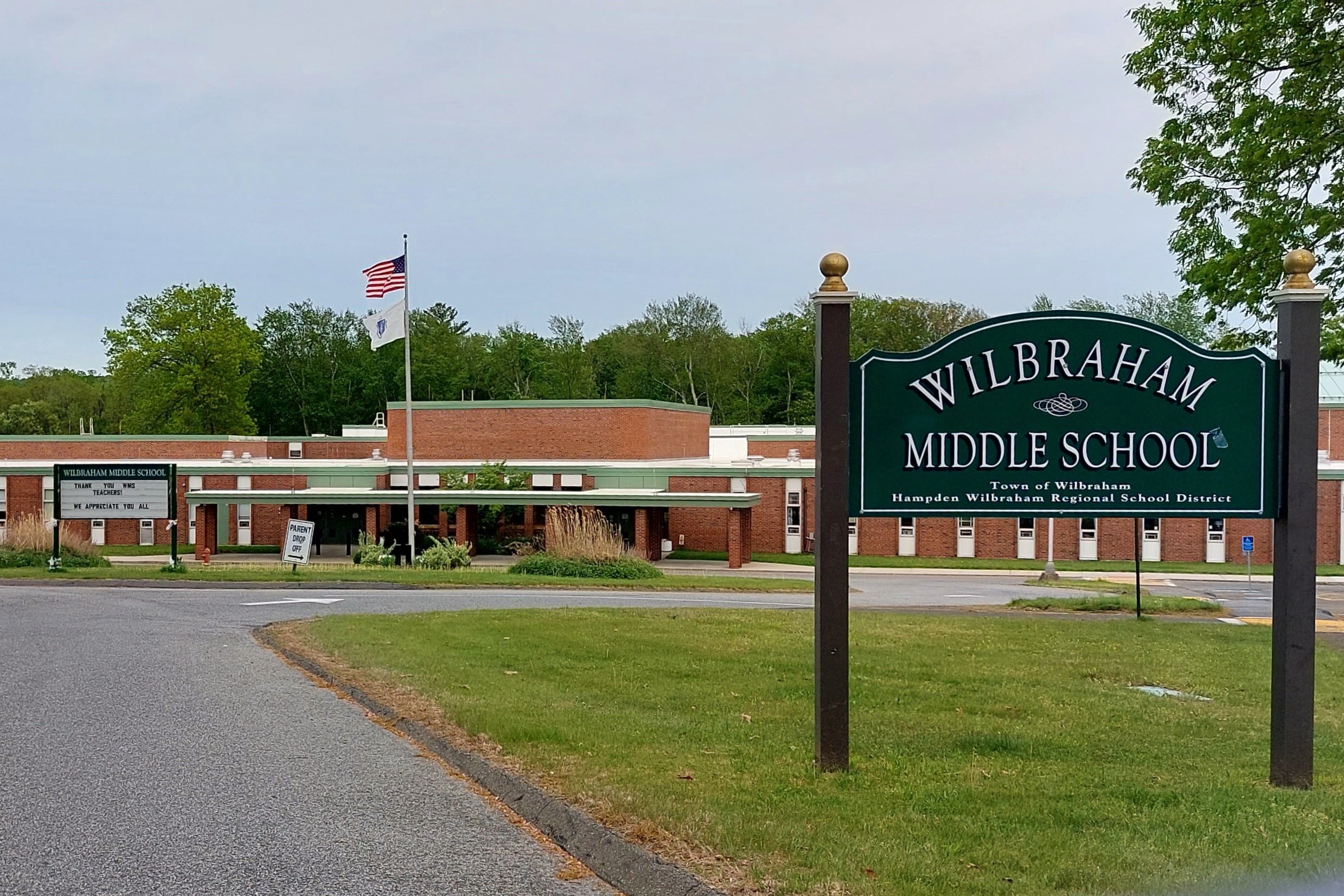
WILBRAHAM — While the future of Wilbraham Middle School is still up in the air, the Hampden-Wilbraham School District School Committee met with the Select Board on Nov. 24 for advice on where to move forward in the MSBA project.
The School Committee discussed the potential of withdrawing from the MSBA’s accelerated repair program and instead applying for the core building program during their meeting on Nov. 20, and sought the Select Board for an idea on where they stood.
To be accepted into the core building program, the MSBA would be looking for approval from both Hampden and Wilbraham’s select boards.
“This is not a pathway for just the School Committee,” committee member Michael Tirabassi said. “A successful core building program project happens with great collaboration between the School Committee and the select boards. This is a team effort.”
Where it stands, the accelerated repair program will fix the doors and windows at Wilbraham Middle School. The core building program would instead focus on new construction, renovations and additions.
Select Board member Marc Ducey’s biggest question out of the gate was where the middle school fit in the district’s future for the next 30 years.
Committee member Michael Tirabassi told the Select Board that they are gathering every fact about Wilbraham Middle School, and what they know is that it isn’t currently meeting the students’ needs due to the age and envelope of the building. Tirabassi also discovered that a 2015 feasibility study for the school showed the failure of every major operating system, such as the water and sanitation system, the HVAC system and the fire protection system.
“If we spend $7 million to $10 million of taxpayer money doing windows and doors on that building, we’re still gonna end up needing to do the core project afterwards,” Tirabassi said. “It would be a total nightmare if the result at that point was that we needed a new building. We would have wasted a lot of resources doing windows and doors.”
Superintendent John Provost added that the educational landscape in society has changed since the school was built and didn’t account for accessibility, special education accommodation or technology.
“As soon as you walk through the front door, you’ll see a plaque immediately to the right that says ‘Wilbraham Junior High.’ Junior high is a concept very popular in the [19]60s and [19]70s,” Provost said. “Education has changed from the 60s to now … Every 45 minutes a bell would ring and we’d move a bunch of kids from one box to another box, and at the last one, we’d move them out … I don’t even think a keyboard was invented as an input device for a computer.”
Provost added that in his four years with the school district, they’ve had major plumbing issues, blown pipes have evacuated the school, mold issues, flooring issues and the inability to address the HVAC system because of equipment made irreplaceable due to the old age.
One of Ducey’s questions for the School Committee looked at the New England School Development Council’s predictions that the school district will rise from 589 students to 773 over the next 10 years. He wondered why the application into the accelerated repair program happened over the core program if the problems in the school were so apparent.
“We thought that the direction we had from the Capital Planning Committee was to leverage as much money as we could from the accelerated repair,” Provost said.
Select Board Chair Michael A. Squindo said he understands the logic but also brought in several concerns surrounding withdrawal from the accelerated repair program, including the potential for being denied and delaying urgent needs that need to be fixed, like the doors and windows. Additionally, if they get accepted into the core program, it may still be a number of years until anything gets done.
“What do we do between now and then to fix the issues that we have today,” Squindo said. “What’s the vision for the School Committee … what’s the best educational future for our kids, what does it look like?”
Squindo also asked the School Committee to see what tools are available as well to get to that vision, because there are true needs in the school that need to be addressed “today.” Select Board member Susan Bunnell added that these things “only happen when there’s a community behind it.”
For now, the School Committee will need to start finalizing consideration into withdrawing from the accelerated repair program while the Select Board still needs time to discuss the best route forward before the core program application deadline from January to April.
“If we do it, we want to do it right,” Tirabassi said. “We wanna go out 110%.”